In July 2026, Meta introduced a series of advertising product and policy updates, covering lead ad optimization, placement and conversion location value rules, dating ad policies, and Facebook ad comment management features.
This article highlights 4 key Meta Product Updates to help advertisers quickly understand the latest features and how they can be applied in practice.
Update 1: Lead Ads Introduce “Maximize Conversion Value”, Creating New Opportunities to Improve ROAS
Previously, “Maximize Conversion Value” was primarily available for the Sales objective. Meta has now expanded this optimization option to the Lead Generation objective. When advertisers use a website as the conversion location, they can select “Maximize Conversion Value” for supported conversion events, rather than being limited to “Maximize Number of Conversions” as the optimization goal.
This update is particularly suitable for advertisers whose leads vary significantly in value and who are able to send value information through conversion events. By providing a value signal for each conversion, Meta AI can further help advertisers allocate budget toward leads with greater business value.
What Types of Advertisers Are Best Suited for This?
- Advertisers with clear early revenue signals: Lead aggregators and publishers, or travel/education businesses where potential customers clearly indicate their expected spending at an early stage.
- Advertisers with longer consideration periods and lead scoring available: Particularly suitable for businesses where leads have a wide range of conversion probabilities.
How to Get Started?
To use “Maximize Conversion Value” as a performance goal, advertisers must first send the corresponding value information for the conversion event they want to optimize.
If events are sent through Meta Pixel, the following parameters can be added to the event:
- value
- currency
For detailed setup instructions, refer to the official Meta Pixel documentation.
If using the Conversions API (CAPI), the setup logic is the same as for purchase events. The currency and valueparameters can be added to the custom_data payload.
For more details, refer to the official Conversions API documentation.
For businesses where lead values vary significantly, this update means that Lead Generation can go beyond simply acquiring “more leads” and further optimize toward “higher-value leads.”
Update 2: New Entry Points for Placement and Conversion Location Value Rules
Meta has further simplified the setup process for Placement Value Rules and Conversion Location Value Rules.
Advertisers can now create or apply value rules directly during campaign creation through the relevant Placement or Conversion settings, without having to navigate to a separate page.
What Are Value Rules?
Advertisers often have a better understanding of their own business value than the advertising system does. For example:
- Which customer segments have a higher lifetime value (LTV)
- Which ad placements generate better business outcomes
- Whether the website or app is a more profitable conversion channel
Value Rules allow advertisers to translate these business insights into signals that can guide ad delivery.
By increasing or decreasing the bid value for specific conditions, advertisers can directly signal to Meta AI which conversions matter more to their business, helping guide the system’s delivery decisions.
For example, if Instagram Reels generates a higher average order value, or if app users have a significantly higher LTV than website users, advertisers can use value rules to increase the relative value of these sources.
According to Meta, using value rules to guide delivery can further improve conversion performance among high-value audiences.
What Are the Benefits of Using Value Rules?
- Align ad delivery more closely with actual business value Instead of focusing solely on the number of conversions, advertisers can concentrate their budget on the customers, placements, or conversion channels that matter most to their business.
- Use with Advantage+ In addition to benefiting from the scale and strong performance delivered by automation, advertisers can also communicate the business values they prioritize most.
- Does not restart the learning phase Creating or applying value rules will not cause the ad set to re-enter the learning phase.
How Much Should You Set for Value Rules?
Meta recommends starting with the company’s own data. For example, if the LTV of a particular customer segment is 40% higher than that of other customers, advertisers can start by testing a +40% value adjustment.
For performance campaigns, Meta recommends starting with an adjustment of at least +50% for the most valuable placements or conversion channels. For brand campaigns, advertisers can start with +20% and continue adjusting based on actual performance.
How to Set Up Placement Value Rules
Go to the “Placements“ in Ads Manager. If you have not created any value rules yet, select “Create a Rule Set.” If you have previously created rules, you can apply an existing “Rule Set” directly.
Currently, values can be adjusted for supported placement types, including:
- Facebook Feed
- Facebook Stories
- Facebook Reels
- Instagram Feed
- Instagram Stories
- Instagram Reels
- Audience Network
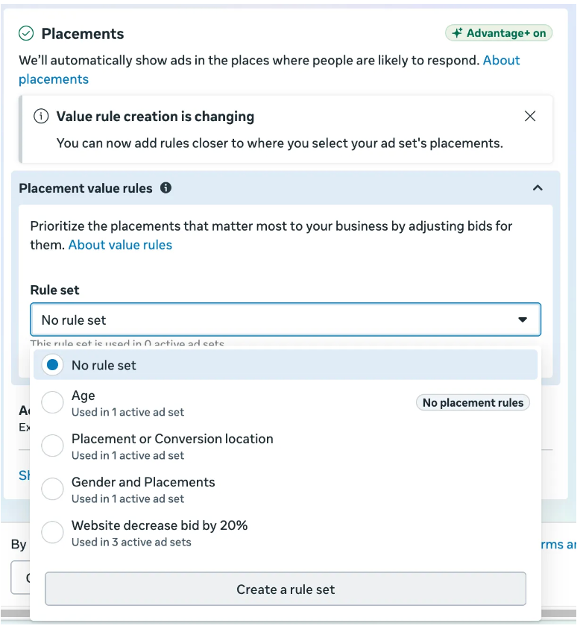
Use Case: Instagram Reels Generates Higher Order Value
Suppose a DTC beauty brand finds that the average order value of conversions from Instagram Reels is twice that of other placements.
The brand still wants to maintain broad ad delivery rather than limiting its ads exclusively to Reels. In this case, it can use Advantage+ placements together with Placement Value Rules to increase the relative bid value of Reels placements.
This allows the brand to guide Meta AI to allocate more delivery opportunities toward higher-value placements without significantly restricting its overall reach.
How to Set Up Conversion Location Value Rules
Go to the “Conversion” within the ad set. Under the selected conversion location, you will find the option to configure Conversion Location Value Rules.
Follow these steps:
- Select a conversion location, such as “Website and App.”
- Find the “Conversion Location Value Rules” section.
- Select “Create a Rule Set,” or apply an existing rule set.
- Set the value increase or decrease for a specific conversion location.
- Save and publish the ad set.
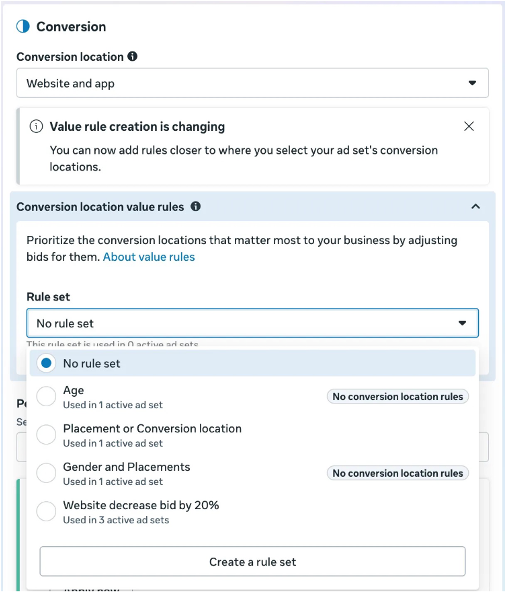
Use Case: App Users Have a Higher LTV Than Website Users
Suppose an advertiser runs both website and app conversion ads and finds that the LTV of app purchasers is 60% higher than that of website purchasers.
In this case, under the “Website and App” delivery setup, the advertiser can apply a +60% value adjustment to app conversions.
This allows Meta AI to retain conversion opportunities across both the website and app while prioritizing budget toward app users with higher long-term value.
Related Resources
Update 3: Meta Updates Its Dating Ads Policy
Effective June 24, Meta updated its Dating Ads Policy, revising policy language and expanding the scope of permitted content to better reflect the diversity of modern relationship types while continuing to protect user safety across its platforms.
The update was primarily introduced in response to market developments and feedback from clients and partners.
What Changes Should Advertisers Be Aware Of?
Meta now allows dating ads related to consensual non-monogamy. However, such content must still meet the following requirements:
- Dating or romantic relationships must be the primary context of the ad.
- Ads must target audiences aged 18 or older.
Meta has also revised its policy language to more clearly define dating- and marriage-related content that remains prohibited, including:
- Relationships involving the exchange of money or other benefits
- Transactional marriage or dating services, such as mail-order bride services
Existing Requirements Still Apply
Dating service advertisers must continue to comply with all other applicable Meta advertising policies, including:
- Adult Sexual Solicitation and Sexually Explicit Language
- Adult Nudity and Sexual Activity
- Privacy Violations and Personal Attributes
- Fraud, Scams and Deceptive Practices
Content promoting prostitution or seeking sexual encounters remains prohibited. In addition, dating service advertisers must still obtain prior approval from Meta before running related ads. Advertisers are required to submit the Dating Service Advertiser Application Form and receive written approval from Meta before publishing ads.
For the complete policy details, please refer to:
Update 4: Facebook Moderation Assist Now Supports Ad Comments
Meta has expanded the scope of Facebook Moderation Assist. Previously, Moderation Assist was primarily used to manage comments on organic posts published by Facebook Pages. Now, the same rules will also apply to comments on Facebook ads.
With Moderation Assist, Pages can automatically hide comments that meet predefined criteria, reducing the time administrators need to spend reviewing ad comments individually.
Existing Users Do Not Need to Reconfigure Their Settings
If a Facebook Page already has Moderation Assist rules in place, no additional action is required.
Existing rules will automatically be extended to comments on Facebook ads associated with that Page.
How to Set Up Moderation Assist
- Go to the Facebook Page’s Professional Dashboard.
- Click “Engagement” on the left-hand side.
- Select “Moderation Assist.”
- Create rules for automatically moderating Facebook comments.

When comments on a Page post or ad meet the predefined criteria, the system will automatically hide the relevant comments.
Administrators can also go to the “Activity Log” tab to review comment moderation actions performed automatically by the system or manually by administrators.
With this update, Facebook ads can benefit from the same automated comment management mechanism as organic posts. For advertisers with high ad volumes, large numbers of comments, or greater brand safety management needs, this can further reduce the day-to-day workload and costs associated with social media management.
For more information, please refer to Meta Moderation Assist Help Center.
Struggling with Brand Development and Marketing?
Reach out to us, and let the professional consultancy team at cacaFly to collaborate with you in creating a brighter future!
PM: cacaFly Malaysia Facebook
Email: [email protected]
Mobile: 017-7486433
cacaFly Malaysia is always at the forefront of digital marketing and committed to being the most reliable partner of our clients, priding ourselves in offering premium services with utmost enthusiasm and professionalism. Specializing in serving brand and performance oriented clients, our one-stop digital marketing services ranges from early research, mid-term advertising, MarTech application and creative production to data analysis and strategy optimization, cacaFly Malaysia has assisted countless brands and online merchant improve their performance and expand their businesses. If you need help with digital marketing strategy, ad placements etc., contact us now! PM us on cacaFly Malaysia Facebook or email us at [email protected]
Source: Meta