Update 1: Smarter Bid Strategy Calibration Means More Predictable Performance
Starting August 17, 2026, Google will update how Search, Shopping, Performance Max, and Demand Gen campaigns using Target CPA (tCPA) and Target ROAS (tROAS) bidding strategies are optimized.
What happened before?
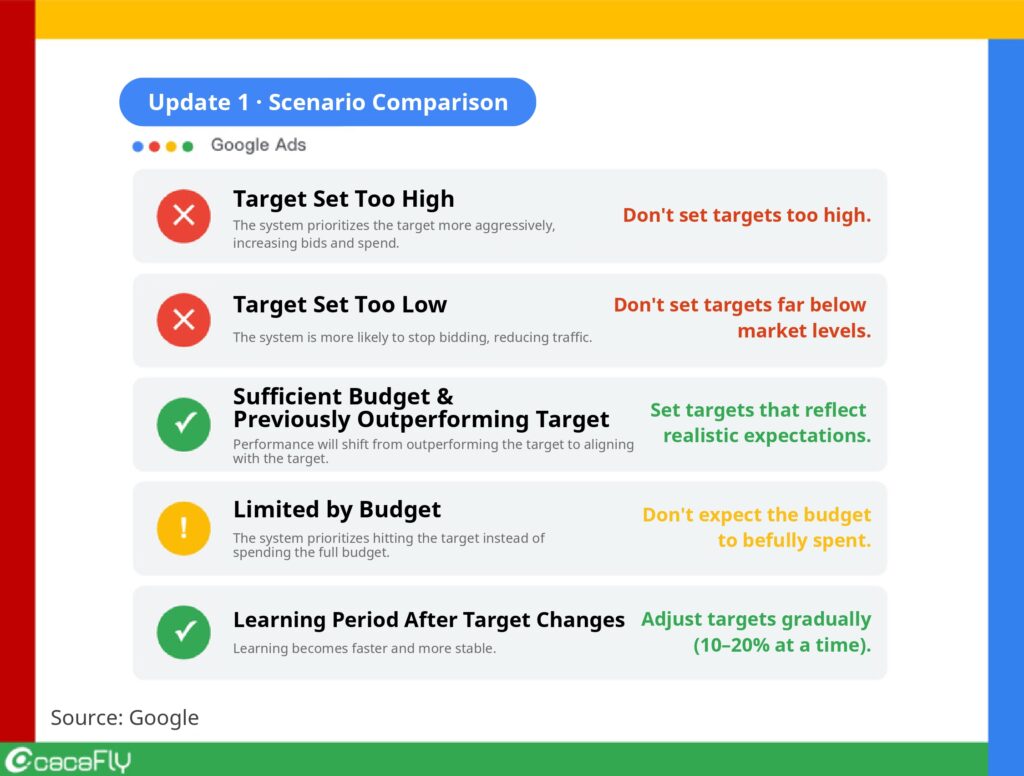
Budget-constrained campaigns often performed better than the advertiser’s target. That looked like a positive result. However, performance could drop once budgets increased or bidding changed. As a result, many advertisers were hesitant to scale.
What’s changing?
With this update, budget-constrained campaigns will deliver results that align more consistently with the performance targets advertisers originally set, rather than fluctuating based on budget limitations. In other words, your target becomes a more reliable forecasting benchmark instead of just a reference point.
What this means for advertisers
Check whether your campaign is currently Limited by Budget. Then compare your actual CPA or ROAS from the past 14–28 days with your target. If your actual results have consistently outperformed the target, your current goal may be too conservative. After August 17, campaign performance will gradually move closer to your target instead of maintaining those stronger historical results.
Recommended action
Review your performance before August 17. Compare your target with your actual CPA or ROAS over the past 14 and 28 days. Then decide whether to keep your current target to unlock more scale, or adjust it to better match recent performance. This can help avoid unexpected changes after the update.
(Target-based bidding strategy update)
Update 2: Google Display Campaigns Are Moving into Demand Gen
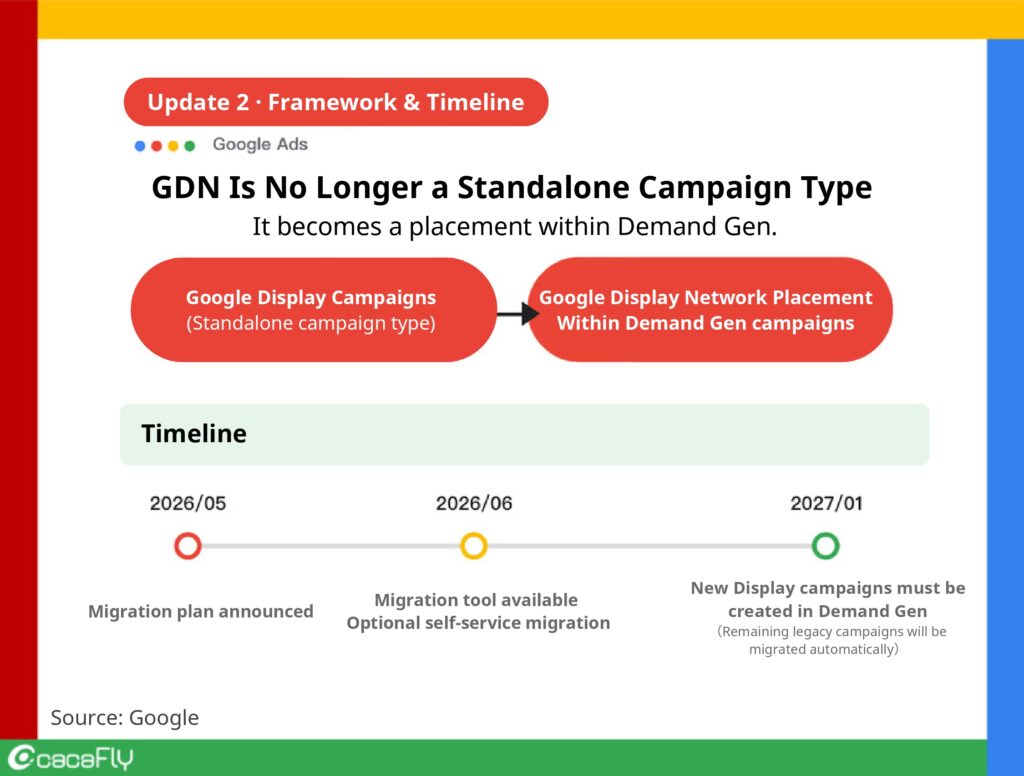
Google is gradually integrating the Google Display Network (GDN) into Demand Gen, making Display inventory a placement option within Demand Gen rather than a standalone campaign type.
Timeline
Beginning June 2026, eligible advertisers can use Google’s migration tool to move existing Display campaigns into the Google Display Network placement within Demand Gen. Starting January 2027, all new Display campaigns must be created under the Demand Gen framework, and any remaining legacy Display campaigns will be migrated automatically.
What this means for advertisers
This update is more than a product redesign. It reflects Google’s shift toward AI-driven campaign optimization. Instead of focusing on placements, the system will rely more on audience signals and creative assets. This follows the same direction as the bidding update. Google’s AI will have richer signals and can make more accurate optimization decisions.
Recommended action
If your brand still relies mainly on Display campaigns for reach, start preparing now. Learn how Demand Gen handles creative assets and placements. Test the migration while the tool is available. Early testing will give you more control than waiting for automatic migration in 2027.
(Google Display campaigns are moving to Demand Gen)
Update 3: Message Ads Bring Search Intent Directly into Conversations
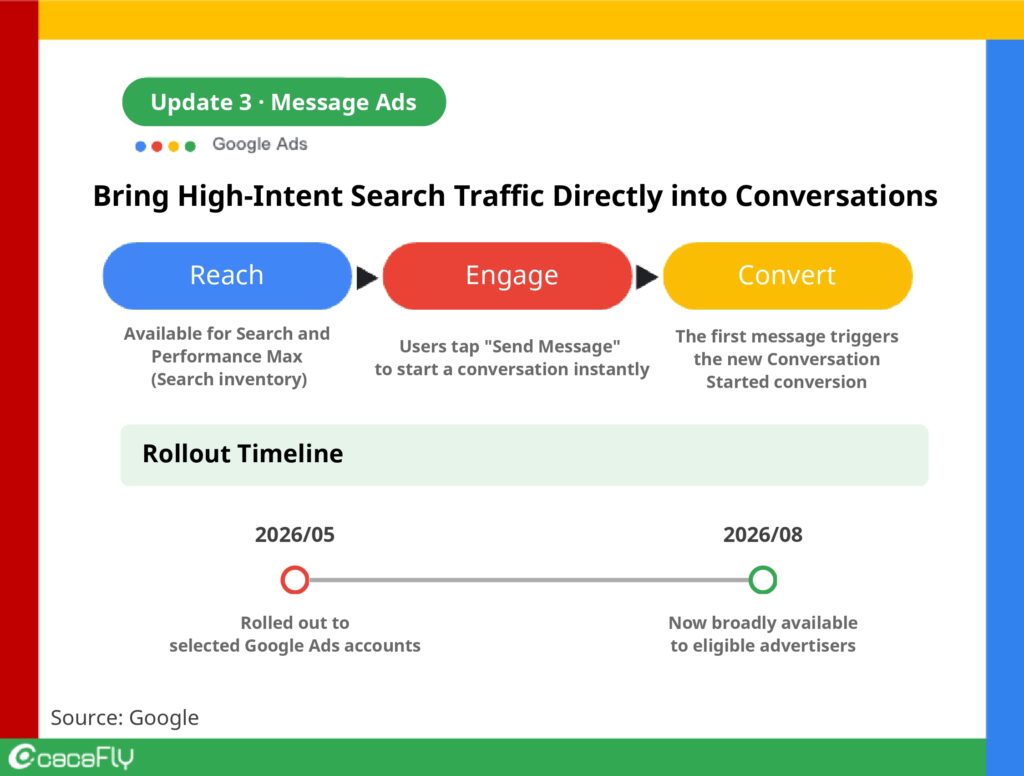
Google has introduced Message Ads for Search and Performance Max campaigns. The new creative lets users start a conversation with a brand directly from an ad. They no longer need to visit a landing page first.
Message Ads began rolling out to selected Google Ads accounts in May 2026. They are now broadly available to eligible advertisers.
How it works
Message Ads can appear as a message extension below a search ad. They can also appear as a standalone message ad. Clicking the headline still takes users to the advertiser’s website. Tapping “Send Message” starts a conversation with the brand instead. The feature is currently available on Android and iOS devices.
A new conversion action
Google now records a new conversion called Conversation Started. It is triggered when a user sends their first message. This gives advertisers a new optimization signal. Campaigns can optimize for real customer engagement instead of relying only on clicks or website visits.
What this means for advertisers
Message Ads are especially useful for businesses that rely on one-to-one conversations. This includes brands offering consultations, appointments, or personalized services. Instead of losing potential customers after they reach a website, advertisers can move users directly from search intent to conversation.
Recommended action
If your business already has an active messaging channel, review your account before enabling Message Ads. Make sure it meets Google’s eligibility requirements. These include policy compliance, advertiser verification, and industry eligibility. Prepare your welcome message and messaging account in advance. That way, you can start turning high-intent search traffic into conversations as soon as the feature is available for your account.
Struggling with Brand Development and Marketing?
Reach out to us, and let the professional consultancy team at cacaFly to collaborate with you in creating a brighter future!
PM: cacaFly Malaysia Facebook
Email: [email protected]
Mobile: 017-7486433
cacaFly Malaysia is always at the forefront of digital marketing and committed to being the most reliable partner of our clients, priding ourselves in offering premium services with utmost enthusiasm and professionalism. Specializing in serving brand and performance oriented clients, our one-stop digital marketing services ranges from early research, mid-term advertising, MarTech application and creative production to data analysis and strategy optimization, cacaFly Malaysia has assisted countless brands and online merchant improve their performance and expand their businesses. If you need help with digital marketing strategy, ad placements etc., contact us now! PM us on cacaFly Malaysia Facebook or email us at [email protected]