

The 2025 League of Legends World Championship officially concluded in early November. According to Esports Charts statistics, over 6 million concurrent viewers watched this esports feast, proving once again that esports has become a global entertainment phenomenon that cannot be ignored. Behind this massive traffic are countless young souls cheering for victory and shedding tears over defeat. This collective frenzy that transcends national borders is the most critical marketing currency of our time, known as passion.
When traffic dividends and the fan economy are tightly interwoven, how should brands position themselves? This article will outline the esports market dynamics worth paying attention to this year to help brands find a clear direction amidst intense competition.
Market Scale Continues to Expand with Asia-Pacific Leading Global Viewership
Comprehensive market research indicates that the esports industry will continue its steady growth in 2025, and it is expected to expand its scale along a clear upward curve over the next decade. Although the growth rate has slowed compared to the pandemic period, the industry has moved from an early explosive stage to a new era of scalability and mature business models.
In the global market, the Asia-Pacific region firmly holds the position of the largest esports market, capturing 51% of viewership share, making it the core stage for brands to build volume and voice. North America leads the world in revenue, generating over 600 million USD through its mature commercialization models. meanwhile, Latin America and the Middle East are rising stars, emerging with the fastest annual growth rates and gradually becoming new battlefields where brands and platforms are competing to establish a presence.
Audience Structure Becomes More Diverse with Young People as the Main Driver
The scale of the global audience is expected to surpass 640 million people in 2025. This massive audience group consists of approximately 290 million core enthusiasts and about 350 million occasional viewers. The former provides high-stickiness interaction value, while the latter brings extensive reach for brands.
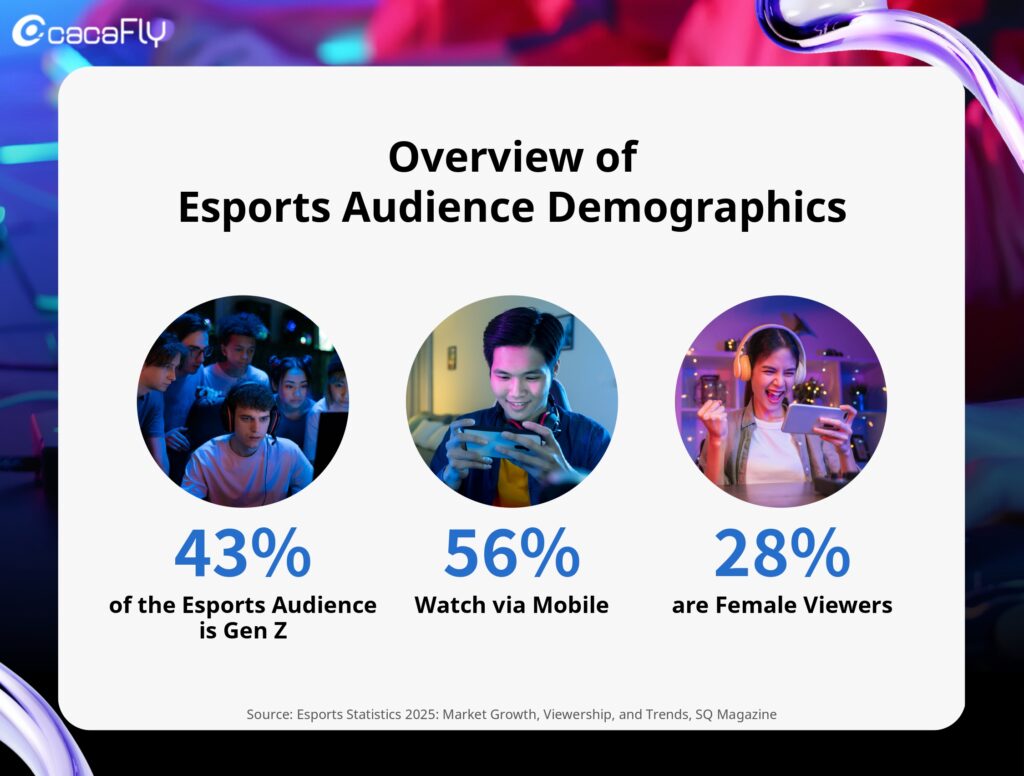
Looking further at the audience profile, the 18 to 34 age group remains the main force in global esports. Among them, Gen Z has the highest proportion and is expected to account for 43% of global esports viewers in 2025, highlighting the influence and participation intensity of esports among young groups. At the same time, the proportion of female viewers continues to climb, showing that esports is gradually stepping out of a single-demographic framework to become a mainstream entertainment option across different groups.
Esports Viewing Shifts to Multi-Platform with Content Forms Evolving Fully
As the esports ecosystem continues to expand, streaming platforms have become the primary window for viewing. Twitch still controls the largest global viewing volume, occupying 71% of global watch hours. YouTube Gaming has accumulated over 1.1 billion hours of watch time by leveraging algorithm recommendations and diverse content advantages. TikTok Live, which has risen in recent years, is quickly joining the fray with a 39% annual growth rate, becoming an important stronghold for brands to capture young groups.
Over 56% of viewers worldwide watch matches via mobile phones, reflecting that the immediacy of content perfectly fits the fragmented entertainment rhythm of the current era. Content forms are also becoming increasingly diverse. Co-streaming, match analysis, and short video highlights have become the main forces for sustaining the heat of tournaments. These formats not only have the opportunity to break through echo chambers but also serve as entry points to convert casual passersby into core fans.
Esports has evolved into a cross-platform, multi-rhythm, and all-encompassing ecosystem. For brands, content must be where the audience is. Precision layout across multiple touchpoints is the key to winning attention.
Multiple Industries Compete in the Esports Market where Precision Marketing is Key to Victory
As the esports audience structure diversifies, brand layouts are also moving towards a stage that is more precise and content-oriented. Data shows that up to 62% of Gen Z discover new brands through games, and 45% actively follow social media accounts after contact, indicating that esports possesses powerful brand penetration capabilities. Furthermore, 72% of esports audiences prefer personalized ads. Driven by AI, brands can transform esports into a communication field for deep segmentation.
In 2025, commercial cooperation models have evolved into more detailed multi-level integrations:
- Teams or Players: Accumulating brand recognition by binding fan emotions through jersey sponsorships, social media content, and co-branded merchandise.
- Leagues or Tournaments: Integrating live streaming and offline events to rapidly expand brand exposure and authority.
- Content Creator Collaborations: Combining streamers and esports KOLs to enter the daily lives of viewers in a more natural way.
- In-Game Events: Replacing traditional ads with interactive mechanisms to enhance engagement.
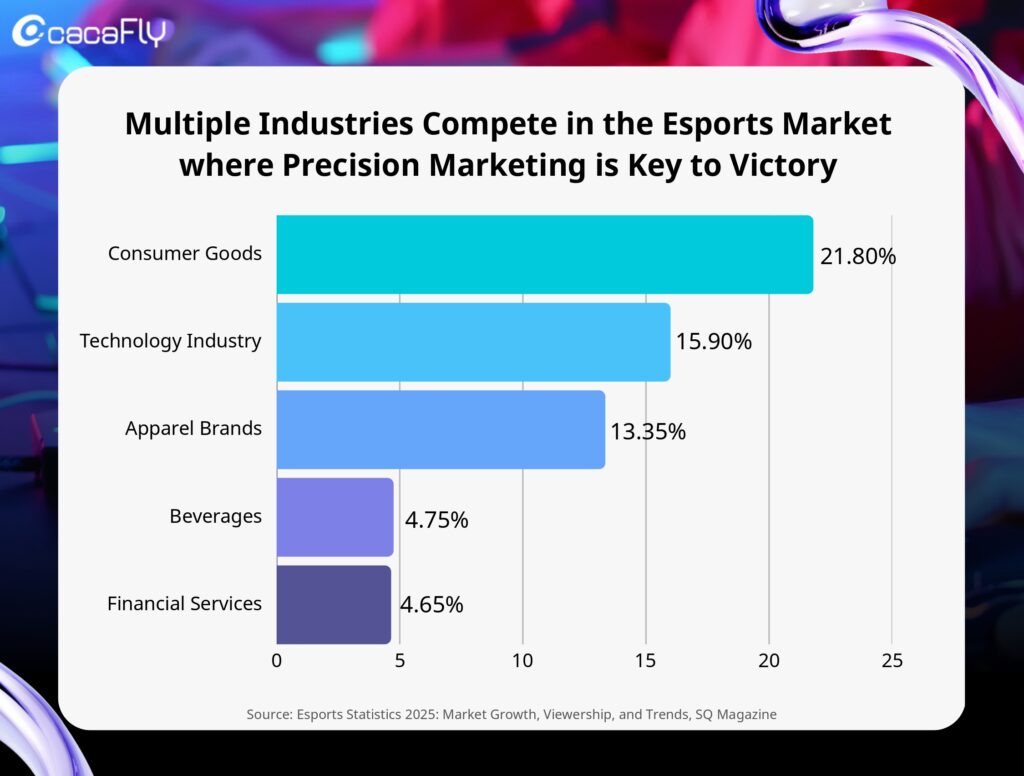
Esports marketing is no longer limited to technology hardware but has extended to multiple industries such as food, clothing, housing, and transportation. Among them, consumer goods, the technology industry, apparel brands, beverages, and financial services are the top five categories investing most actively. If brands can flexibly utilize data insights and combine AI technology with content co-creation, they can precisely capture the mind share of target audiences in this fierce war for attention.
Conclusion
The esports industry has transformed into a mainstream entertainment form possessing massive traffic, deep interaction, and cross-platform extensibility. More importantly, esports can inspire viewers to actively invest emotion, time, and action, making it one of the most potential-filled media fields for brands to reach the younger generation. Facing this cross-platform and cross-industry competition for attention, the key for brands lies in whether they can deeply understand the digital footprints of their audience and create content experiences that possess high interactivity and emotional resonance.
As market mechanisms mature, now is the critical turning point for layout. Only brands that gain insight into trends and act decisively can transform traffic dividends into long-term brand assets in this wave.
Struggling with Brand Development and Marketing?
Reach out to us, and let the professional consultancy team at cacaFly to collaborate with you in creating a brighter future
PM: cacaFly Malaysia Facebook
Email: [email protected]
Mobile: 017-7486433
cacaFly Malaysia is always at the forefront of digital marketing and committed to being the most reliable partner of our clients, priding ourselves in offering premium services with utmost enthusiasm and professionalism. Specializing in serving brand and performance oriented clients, our one-stop digital marketing services ranges from early research, mid-term advertising, MarTech application and creative production to data analysis and strategy optimization, cacaFly Malaysia has assisted countless brands and online merchant improve their performance and expand their businesses. If you need help with digital marketing strategy, ad placements etc., contact us now! PM us on cacaFly Malaysia Facebook or email us at [email protected]
Source
Esports Statistics 2025: Market Growth, Viewership, and Trends, SQ Magazine
Global games market to hit $189 billion in 2025 as growth shifts to console, Newzoo
eSports Statistics 2025 (Market Size, Viewership & Trends), Esports Stats
Top 20 Video Game Marketing Statistics 2025, Amra & Elma